
Flying Close to the Sun
Two potentially bright comets grace April's sky alongside planetary conjunctions and the Lyrid meteor shower. Astronomer Alan Hale guides us through the month's celestial highlights.
Our solar system's two brightest planets shine in April's evening sky. Venus continues its slow and gradual climb into the western sky and sets slightly after the end of dusk. On the evening of April 23, it appears near the Pleiades star cluster in Taurus. Meanwhile, Jupiter is high in the western sky as darkness falls and sets in the west one to two hours after midnight.
For all practical purposes, our morning sky is devoid of planets this month. Mercury is low in the dawn throughout most of the month, and it is joined by Mars and Saturn as they begin making their respective climbs into the morning sky. The three worlds have a series of conjunctions with each other between April 19-21, but it takes place deep in morning twilight and will not be easy to see.
The Lyrid meteor shower should peak around Wednesday morning, April 22, and may produce 10 to 15 meteors per hour. The moon will be a couple of days before its first quarter phase and will set in the late evening. It won't interfere with viewing.
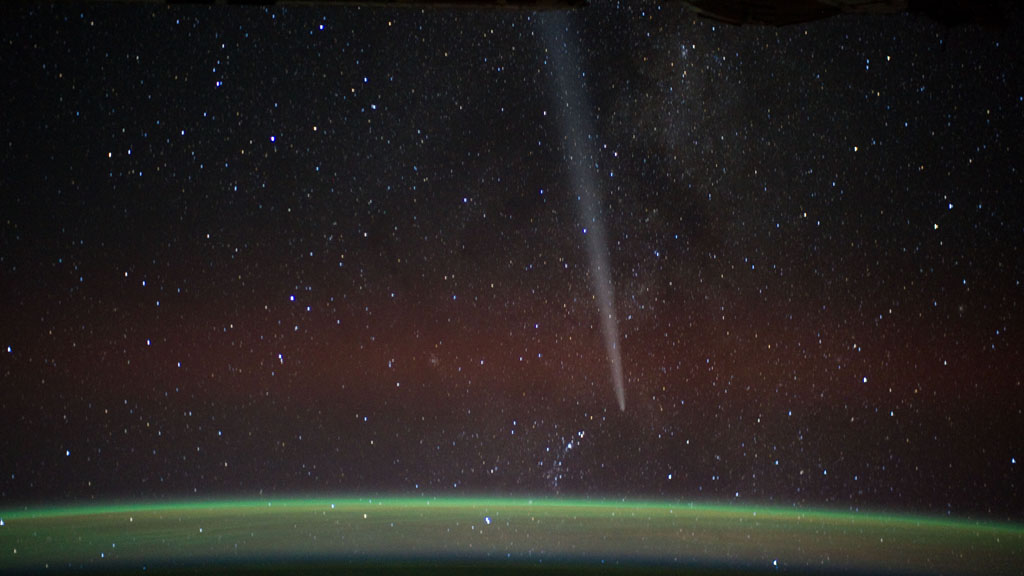
With April comes not one, but two potentially bright comets in our sky. Comet MAPS, discovered in January by a quartet of French amateur astronomers using a remote-controlled telescope in Chile, is a type of comet known as a Kreutz sungrazer. These are believed to be fragments of a larger comet that broke apart many centuries ago. As the term sungrazer implies, these comets pass extremely close to the sun. Some of the brightest comets in recorded history have been such objects.
Comet MAPS will be closest to the sun Saturday, April 4, and before that date will be approaching the sun in the evening sky. If it survives its close brush by the sun, it will again appear in the evening sky, low in the Southwest, in subsequent days.
It is difficult to predict just how bright Comet MAPS might become. In theory, it could become a brilliant object—although the show will likely be fairly brief. On the other hand, it might disintegrate entirely, and there won't be anything at all significant to see.
Meanwhile, a comet discovered in September by the Pan-STARRS program in Hawaii will be visible low in our morning sky during April. For about a week and a half around mid-month, it crosses west-to-east across the southern part of the "Great Square" of the constellation Pegasus. It then disappears into the dawn within the next week.
It should be easily detectable with a pair of binoculars, and may become bright enough to be dimly visible to the unaided eye.